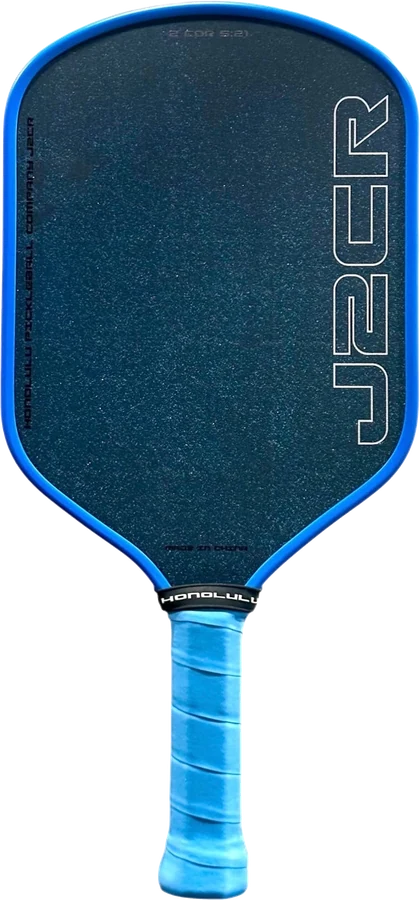
Almost nobody famous plays the Honolulu J2CR Crystal Blue. As far as I know, there are close to zero pros on it. No signature edition, no tour highlight reel, no sponsored athlete swinging it on a livestream. It's one of the most looked-at paddles in the country anyway, and all of that attention comes from real players telling other real players to buy it.
Here's my bias: I like a little extra mass, I put weighted tape on anything with a handle, and I think the hybrid is the right shape for most people. Adjust accordingly.
The J2CR isn't the sexiest paddle you'll ever hold. It doesn't do any one thing off the charts. It does everything well, and that's why it's the hybrid I recommend more than any other.
Power or all-court? Both, leaning power
The J2CR sits right on the edge between all-court and power, and it leans power. The labs put it in the power band too. What makes it unusual is how it moves. The reviewer average swing weight is 108.7, which is light for a paddle that hits this hard. You get power-paddle output from something that swings like a control paddle.
That light swing is probably why it takes some getting used to. The paddle gets there faster than you'd expect from something with this much pop. It's controllable by most players, but give it a few sessions before you make a decision.
It plays well right out of the box. Then I added my standard setup: a 4 to 5 inch strip of half-gram-per-inch tape on each side, starting at the throat and running up the face. That's 4 to 5 grams total. Stock, the twist weight sits around 6.4, below average, and you can feel it on balls toward the rail. With the tape on, the paddle got more stable and the sweet spot got bigger. It's a $5 fix that takes five minutes, and it's how I'd play the J2CR every time.
Blue Grit: 2,400 RPM that stays
The Crystal Blue face averages 2,448 RPM across the labs, among the highest spin numbers anyone has recorded on a paddle. John Kew rates it Tier 1 for spin durability, his top grade, and his durability tiers are the closest thing pickleball has to a gold standard for grit. Tier 1 means it lost no measurable spin in his test. In practice, you should keep most of that 2,400 for as long as you own the paddle.
That matters more in 2026 than it ever has. Every brand is frantically chasing durable grit right now, and not all of them are making it. Some surfaces fade fast. Some brands are fighting bad batches and inconsistent quality control. I won't name names, but I've seen more grit with problems than without. Knowing your face is Tier 1 out of the box is a cheat code.
And this has nothing to do with how it plays, but the Blue Grit looks amazing. Simple design, cool color. What more can you ask for?
Two handles, and the two-handed backhand question
The question I get in my DMs more than any other, about any paddle, is "does this work with a two-handed backhand?" With the J2CR, the answer is yes, and you get to pick how much room you want.
It comes in two handle lengths: the original at 5.5 inches and an extended version at 6, both measured by Honolulu to include the taper above the grip. I played the original.
For most two-handed backhands, I think 5.5 inches is plenty. If you're worried about it, that extra half inch on the long handle is really nice to have. I love that the choice exists at all: same shape, same face, pick your handle.
Where it lets you down
It's UPA-A approved, not USAP. USA Pickleball's new spin-rate test took effect October 1, and I haven't seen the Crystal Blue approved under it. If you play USAP-sanctioned events, the standard carbon J2CR is the legal version.
Stock, the below-average twist weight shows up on mishits toward the edge. The tape fixes it, but a $195 paddle that's at its best with five grams of tape is still a paddle that needs five grams of tape.
How it stacks up
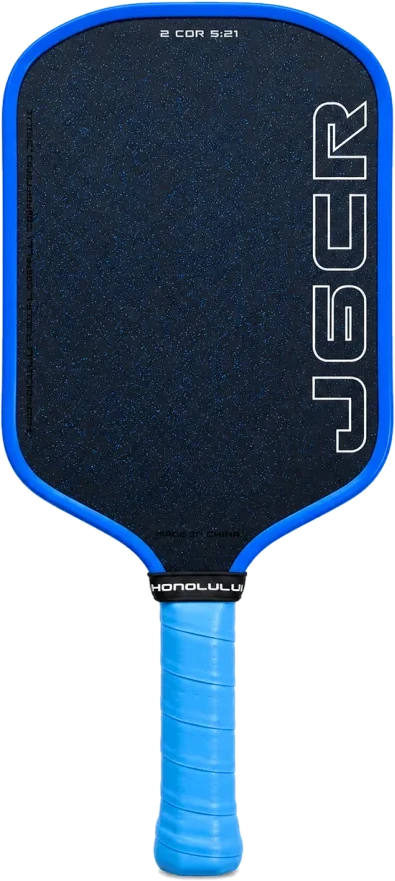
- vs. Honolulu J6CR Crystal Blue: same face, same core, elongated shape. The J6CR has more power and more reach. The J2CR is faster and more controllable. The J6CR scores higher because it's the one I personally reach for. The J2CR is the one I'd hand more people.
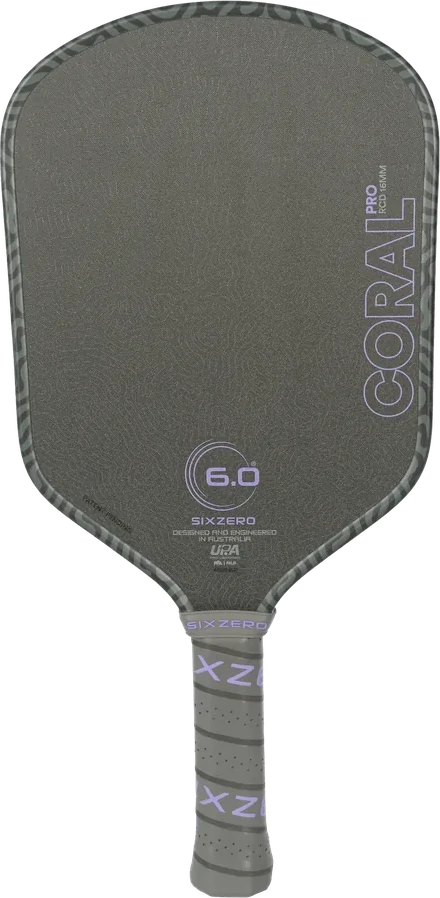
- vs. Six Zero Coral Pro Hybrid: softer, more forgiving, more all-court, and $25 more. If you want plush, Coral Pro. If you want quicker hands and more pop, the J2CR.
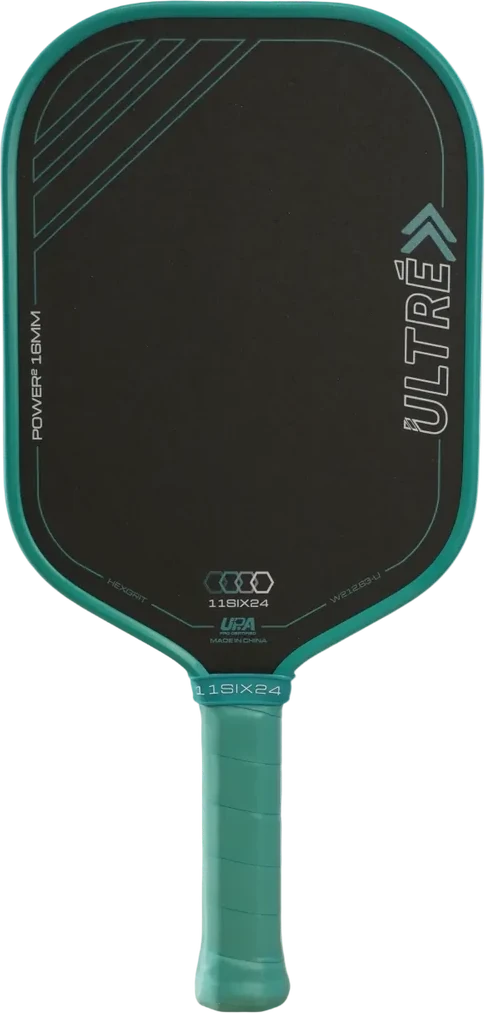
- vs. Volair CMD HYB 16mm: the control hybrid. Pick the Volair if touch is everything. Pick the J2CR if you want to finish points too.
- vs. Honolulu J3CR Crystal Blue: the widebody sibling. Wide bodies are getting harder to find in new launches, and the hybrid has taken over for a reason: it gets most of the reach of an elongated and most of the forgiveness of a widebody without the big drawbacks of either. Still, if you mishit a lot and live at the kitchen line, the J3CR might be the better paddle for you.
Who should buy it
Most people. If you're a 3.0-and-up doubles player who wants one paddle that can drive, drop, reset and finish without making you pick a lane, this is the one I'd point you to first. If you play a spin game, or want to, the face alone justifies the price. If you hit a two-handed backhand, either handle works, and the 6 inch is there if you want the margin.
How I tested
7 hours: drilling, rec doubles and competitive doubles, rotating it against other paddles in the same sessions. Original 5.5 inch handle. Played stock first, then with a 4 to 5 inch strip of 0.5 g/in tape per side from the throat up, 4 to 5 g total. No rig. Specs on the rail are Honolulu's claims except where marked. Spin, swing weight and twist weight are averages of John Kew's database and Matt's Pickleball, both read September 29, 2026. Both labs tested the long-handle version.
Honolulu sent this review unit and is an affiliate partner. Code NICOTHELEFTY takes it to $175.50, and they didn't see this review before you did.